
Why Weld Failures Happen in Nigerian Industrial Facilities – And How Dry MPI Helps Prevent Costly Downtime
In Nigeria’s oil and gas sector, a single undetected weld defect can halt production, trigger environmental incidents, damage critical assets, and put personnel at risk.
Pipelines in the Niger Delta transport crude oil under sustained pressure. Refinery vessels undergo continuous thermal cycling. Structural steel in fabrication yards carries dynamic loads that place every weld under constant stress. In these environments, even a small discontinuity can grow into a major failure if left undetected.
Across the upstream, midstream, and industrial sectors, weld-related failures continue to contribute to unplanned downtime and maintenance costs. In many cases, investigations reveal that the defect responsible for the failure existed long before the incident occurred.
The issue is not always negligence.
More often, it is the inspection method being used.
Many facilities still rely heavily on visual inspection as their primary weld quality assessment tool. While visual inspection remains essential, it is rarely sufficient on its own for critical welds operating under demanding service conditions.
The Real Cost of Weld Failure
Before discussing prevention, it is important to understand the consequences of weld failure.
When a pressure-containing weld fails on a pipeline, vessel, or process system, the impact extends far beyond the repair itself.
A facility may face:
- Production interruptions and revenue loss
- Emergency repair mobilisation costs
- Additional manpower and logistics expenses
- Regulatory investigations and reporting requirements
- Delayed project schedules
- Increased maintenance budgets
- Potential safety and environmental consequences
For fabrication facilities, the cost profile is equally significant.
Discovering a defect after installation often requires cutting out and replacing completed welds, mobilising additional labour, and extending project timelines. A defect detected during fabrication is far less expensive to address than one discovered during commissioning or operation.
The economics are simple:
The cost of an effective inspection programme is typically far lower than the cost of a single preventable failure.
Why Nigerian Operating Conditions Increase Risk
Industrial facilities across Nigeria operate in environments that actively contribute to weld deterioration and crack development.
Humidity and Corrosion
Facilities in the Niger Delta and coastal regions experience high humidity and corrosive atmospheres.
These conditions can accelerate corrosion-related degradation and contribute to cracking mechanisms around welds and heat-affected zones.
Thermal Cycling
Refineries, processing plants, and power facilities experience repeated heating and cooling cycles.
Over time, this constant expansion and contraction can create fatigue cracks, particularly in areas with stress concentrations.
Vibration and Cyclic Loading
Pipelines, compressors, pumps, and rotating equipment generate continuous vibration.
Small discontinuities that appear harmless under static conditions can become crack initiation points when exposed to repeated loading.
Harsh Field Conditions
Dust, contamination, weather exposure, and challenging access conditions can affect both weld quality and inspection effectiveness.
The most common defects associated with these environments include:
- Fatigue cracks
- Toe cracks
- Lack of fusion
- Porosity
- Undercut
- Surface-breaking discontinuities
Many of these defects are surface or near-surface indications that visual inspection alone may not reliably detect.
The Limitations of Visual Inspection
Visual inspection is fast, economical, and essential.
However, it has limitations.
The human eye can only detect defects above a certain size and visibility threshold. Early-stage fatigue cracks are often too small to be seen under normal inspection conditions.
Other practical challenges include:
- Restricted access to weld locations
- Variable lighting conditions
- Surface contamination
- Inspector fatigue
- Complex weld geometries
Visual inspection provides a valuable first assessment.
It does not provide complete confidence that a weld is free from defects capable of causing failure during service.
For that, additional Non-Destructive Testing (NDT) methods are often required.
Understanding Dry Magnetic Particle Inspection (Dry MPI)
Magnetic Particle Inspection (MPI) remains one of the most practical and widely used methods for detecting surface and near-surface discontinuities in ferromagnetic materials.
The principle is straightforward.
When a ferromagnetic component such as carbon steel is magnetised, the magnetic field flows through the material.
If the material is free from defects, the magnetic field remains largely contained within the metal.
However, when a crack or discontinuity interrupts the magnetic path, part of the field escapes the surface, creating what is known as a magnetic leakage field.
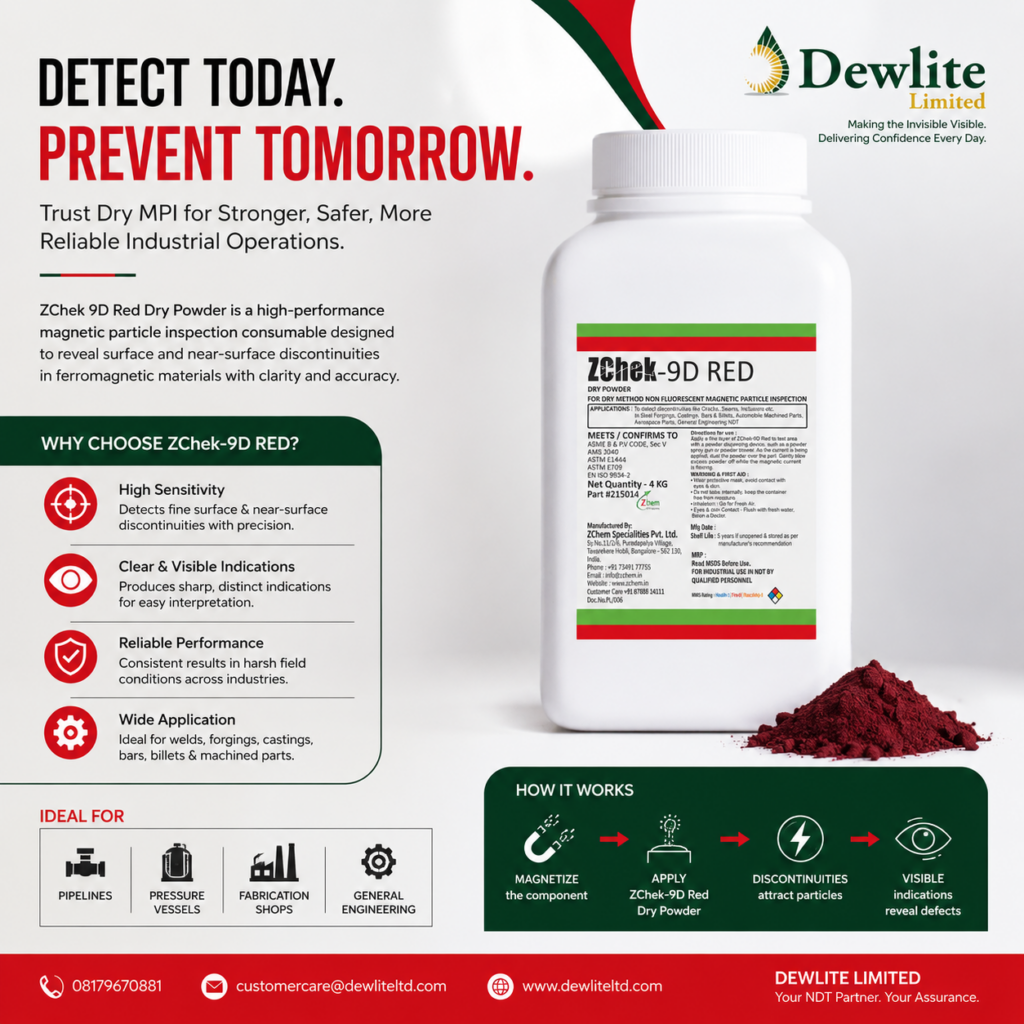
Dry MPI uses finely milled magnetic particles that are applied to the surface while the component is magnetised.
The particles are attracted to the leakage field and gather at the defect location, creating a visible indication that reveals:
- Defect location
- Defect orientation
- Approximate defect length
- Defect severity
This allows inspectors to identify flaws that would otherwise remain undetected.
Why Dry MPI Works Well in Nigerian Field Conditions
For many field inspections in Nigeria, Dry MPI offers practical advantages.
Unlike wet magnetic particle systems, dry powder inspections do not rely on liquid carriers that can be affected by:
- High temperatures
- Evaporation
- Surface contamination
- Dusty operating environments
This makes Dry MPI particularly useful for:
- Pipeline inspection
- Pressure vessel inspection
- Structural steel inspection
- Fabrication yard quality control
- Shutdown maintenance programmes
The method provides immediate results and can be deployed rapidly in challenging field conditions.
The Importance of Proper Magnetisation
Successful MPI depends on correct magnetisation.
Inspectors commonly use an electromagnetic yoke to create the magnetic field required for inspection.
To maximise detection sensitivity, the magnetic field should be positioned perpendicular to the expected defect orientation.
This is why inspectors typically examine the same weld from multiple magnetisation directions.
Without proper field orientation, critical defects can be missed.
This highlights the importance of both qualified personnel and proper inspection procedures.
What Dry MPI Looks Like in Practice
Pipeline Inspection
During maintenance campaigns, inspectors evaluate girth welds and longitudinal seams using portable yokes and dry magnetic powder.
Defects such as fatigue cracks and toe cracks become visible through clear particle accumulations.
Pressure Vessel Inspection
Nozzle welds, shell welds, and repair areas are common inspection targets.
These locations often experience elevated stress and are therefore more susceptible to crack development.
Fabrication Quality Control
Dry MPI is routinely used during fabrication before surface coatings are applied.
Inspecting welds at this stage allows defects to be corrected early, reducing costly rework later in the project lifecycle.
In each case, Dry MPI routinely reveals defects that visual inspection alone may overlook.
Best Practices for Dry MPI in Nigerian Facilities
A reliable Magnetic Particle Inspection programme should include:
Proper Surface Preparation
Inspection surfaces should be clean and free from:
- Heavy rust
- Mill scale
- Dirt
- Thick coatings
Contaminated surfaces reduce inspection sensitivity.
Temperature Verification
Dry MPI performs best within recommended operating temperatures.
Excessive heat can affect inspection quality and should be considered during field work.
Qualified Personnel
Inspectors should possess recognised NDT certifications such as:
- PCN
- CSWIP
- ASNT
- ISO 9712
Qualification matters because accurate interpretation requires more than simply applying powder to a weld.
High-Quality Consumables
Inspection sensitivity depends heavily on consumable quality.
Substandard magnetic particles can reduce the probability of detecting critical defects.
The magnetic powder used during inspection is not merely a consumable—it is a precision inspection tool.
The Right MPI Consumables Matter
Even the most experienced inspector can only work with the materials available.
The effectiveness of a Dry MPI programme depends on the performance of the magnetic particle system being used.
For facilities seeking reliable inspection outcomes, certified and high-quality consumables help improve defect detection capability and inspection consistency.
Dewlite Limited supplies genuine ZChek Magnetic Particle Inspection consumables to inspection teams, QA/QC departments, fabrication yards, and NDT service providers across Nigeria.
From Dry MPI systems to visible and fluorescent MPI solutions, we support inspection programmes designed to meet demanding industrial requirements.
One Defect. One Failure. One Reason to Inspect Properly.
Weld inspection is not a paperwork exercise.
It is a critical risk management process that protects people, assets, production targets, and operational reliability.
A defect that goes undetected today can become tomorrow’s shutdown, repair project, or safety incident.
Dry Magnetic Particle Inspection remains one of the most effective methods for identifying surface and near-surface weld discontinuities before they become costly failures.
The question is not whether inspection matters.
The question is whether your current inspection programme is providing the level of confidence your operation requires.
Need Help Selecting the Right MPI System?
Whether you’re inspecting:
- Pipelines
- Pressure vessels
- Storage tanks
- Structural steel
- Fabrication welds
Dewlite Limited can help you identify the most suitable inspection consumables for your application.
📞 08179670881
📧 [email protected]
Dewlite Limited — Making the Invisible Visible. Delivering Confidence Every Day.
Next in This Series
ZChek 9E Black + WP White Contrast Paint: Choosing and Applying the Right Visible Wet MPI System for Pipeline and Pressure Vessel Inspection in Nigeria.
Need products for your inspection?
Tell us the application, specification and quantity you need.