
Surface Preparation for Maximum Contrast in Visible Magnetic Particle Inspection: A Practical Guide for Nigerian Inspectors
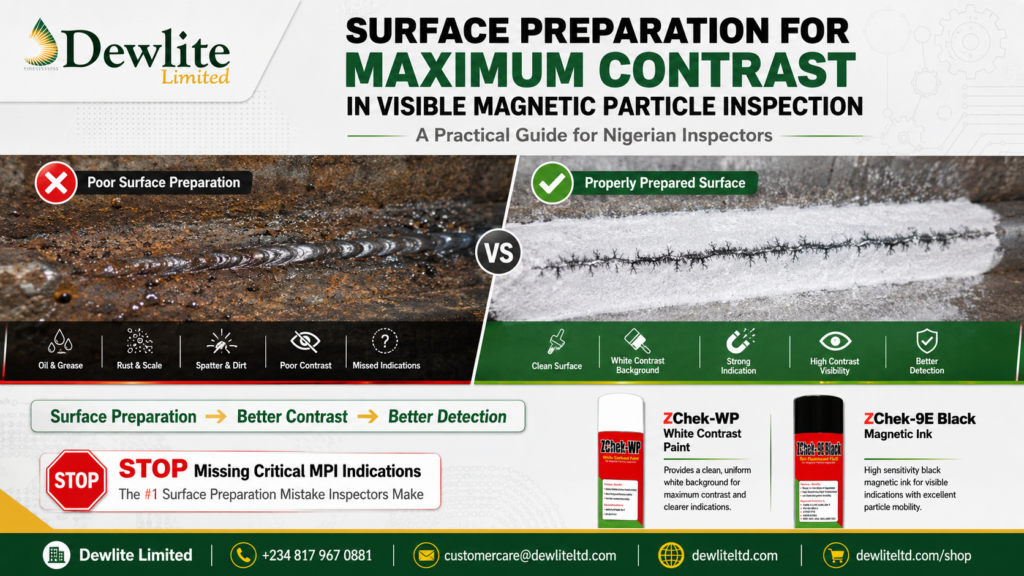
What causes most missed indications during Visible Magnetic Particle Inspection (MPI)?
Many people assume the problem lies with the magnetic particles, inspection equipment, or even the inspector’s skill level. In reality, one of the most common causes of unreliable inspection results is poor surface preparation.
Visible Magnetic Particle Inspection is widely used across Nigeria’s oil and gas industry, fabrication yards, power plants, marine facilities, manufacturing operations, and construction projects because of its ability to detect surface and near-surface discontinuities in ferromagnetic materials. However, even the most advanced MPI consumables cannot deliver reliable results when applied to contaminated or poorly prepared surfaces.
A weld covered in oil, grease, rust, moisture, paint residue, or welding spatter can prevent clear indication formation. This can result in missed defects, false indications, unnecessary rework, and potentially costly failures.
For inspectors using high-performance consumables such as ZChek-9E Black Magnetic Ink and ZChek-WP White Contrast Paint, proper preparation is the foundation of successful inspection.
In this guide, we explore why surface preparation is critical, the common challenges faced by inspectors in Nigeria, practical preparation procedures, and best practices for achieving maximum contrast and detection sensitivity during Visible Magnetic Particle Inspection.
Understanding Visible Magnetic Particle Inspection
Visible Magnetic Particle Inspection (MPI) is a non-destructive testing method used to identify surface and near-surface discontinuities in ferromagnetic materials.
The inspection process involves magnetizing a component and applying magnetic particles to the surface. Whenever a discontinuity interrupts the magnetic field, magnetic flux leakage occurs. The magnetic particles are attracted to these leakage fields and accumulate around the defect, forming visible indications.
Typical discontinuities detected through MPI include:
- Surface cracks
- Fatigue cracks
- Lack of fusion
- Seams
- Laps
- Grinding cracks
- Weld discontinuities
Visible MPI systems commonly use black magnetic particles applied over a white contrast background. The contrast created between the white background and black particle indications significantly improves visibility and interpretation accuracy.
This is why many inspectors rely on combinations such as:
- ZChek-WP White Contrast Paint
- ZChek-9E Black Magnetic Ink
The white background enhances visibility while the jet-black particles create sharp, easily recognizable indications.
However, neither product can compensate for poor surface conditions.
Why Surface Preparation Matters
Surface preparation is often viewed as a preliminary step, but in reality it directly influences inspection sensitivity and reliability.
A properly prepared surface allows magnetic particles to move freely and accumulate at discontinuities. It also enables the white contrast coating to adhere uniformly and create the ideal inspection background.
Poor preparation can cause:
Reduced Indication Visibility
Contaminants can obscure discontinuities and prevent magnetic particles from forming clear indications.
False Indications
Rust, scale, paint defects, and contamination can trap particles and create misleading indications.
Missed Defects
When contaminants interfere with particle mobility, actual defects may not produce sufficiently visible indications.
Increased Inspection Time
Inspectors may spend additional time verifying unclear indications, reducing productivity.
Increased Rework Costs
Missed discontinuities discovered later in fabrication or operation often result in expensive repairs and downtime.
In critical industries such as oil and gas, even a small missed crack can have significant operational and financial consequences.
Common Surface Contaminants That Affect MPI Performance
Oil and Grease
Oil contamination is one of the most common challenges encountered during field inspections.
Residual lubricants, machining oils, hydraulic fluids, and grease can create a barrier between the inspection surface and magnetic particles.
Effects include:
- Poor particle mobility
- Uneven coating application
- Reduced indication clarity
- Increased likelihood of false results
Thorough cleaning is essential before inspection begins.
Rust and Corrosion Products
Corrosion creates rough surface conditions that can interfere with particle accumulation.
Rust may:
- Mask discontinuities
- Produce non-relevant indications
- Reduce inspection sensitivity
Heavily corroded surfaces should be cleaned appropriately before inspection.
Mill Scale
Mill scale frequently appears on fabricated steel components.
This hard oxide layer can:
- Obscure discontinuities
- Prevent proper magnetic particle movement
- Reduce inspection effectiveness
Surface preparation should remove scale whenever practical.
Paint and Coatings
Paint coatings can conceal discontinuities and interfere with magnetic flux leakage.
Inspectors should verify whether coatings exceed acceptable thickness limitations before conducting MPI.
Moisture
Moisture can significantly affect contrast paint adhesion and magnetic particle behavior.
Wet surfaces may produce:
- Uneven contrast coating
- Reduced particle mobility
- Poor indication formation
Components should be dry before inspection.
Welding Spatter
Spatter frequently appears around weld zones.
These surface irregularities can trap magnetic particles and create misleading indications that complicate evaluation.
Proper cleaning improves inspection efficiency and accuracy.
Nigerian Environmental Challenges That Affect MPI Inspections
Inspectors operating in Nigeria face unique environmental conditions that can significantly influence inspection quality.
Understanding these challenges is critical for maintaining inspection reliability.
High Humidity
Many regions, particularly the Niger Delta and coastal areas, experience high humidity levels throughout the year.
Excess moisture can:
- Affect contrast paint adhesion
- Increase drying times
- Reduce inspection efficiency
- Promote surface oxidation
Inspectors should ensure surfaces are completely dry before applying contrast coatings or magnetic particles.
Coastal Salt Exposure
Facilities located near coastal environments are frequently exposed to airborne salt deposits.
Salt contamination can:
- Accelerate corrosion
- Create misleading surface conditions
- Mask discontinuities
Routine cleaning becomes even more important in these environments.
Harmattan Dust
During Harmattan periods, fine dust particles can settle on inspection surfaces.
This contamination may:
- Interfere with contrast paint application
- Affect particle mobility
- Create background noise during evaluation
Surfaces should be cleaned immediately before inspection.
Offshore Conditions
Offshore platforms present additional challenges including:
- Salt spray
- Wind exposure
- Moisture accumulation
- Variable lighting conditions
Inspection procedures should account for these environmental factors to maintain reliability.
High Ambient Temperatures
Many industrial facilities in Nigeria experience elevated daytime temperatures.
Excessive heat can affect:
- Evaporation rates
- Application consistency
- Inspector comfort
- Inspection timing
Proper planning and product handling help mitigate these challenges.
Step-by-Step Surface Preparation Procedure for Visible MPI
Achieving maximum contrast requires a disciplined preparation process.
Step 1: Initial Visual Assessment
Before cleaning begins:
- Inspect the surface condition
- Identify contamination sources
- Assess coating thickness
- Evaluate accessibility
This allows inspectors to determine the most appropriate preparation method.
Step 2: Surface Cleaning
Remove:
- Oil
- Grease
- Dirt
- Dust
- Rust
- Scale
- Paint residue
A clean surface provides the foundation for reliable inspection.
Step 3: Surface Drying
After cleaning:
- Verify complete dryness
- Remove trapped moisture
- Check weld toes and crevices
Moisture remaining on the surface can affect both contrast paint and particle performance.
Step 4: Apply Magnetic Particles
Apply ZChek-9E Black Magnetic Ink while the magnetic field is present.
Benefits include:
- Excellent visibility
- Strong indication formation
- High sensitivity
- Reliable performance in field conditions
Step 5: Apply White Contrast Paint
Apply a thin, uniform coating of ZChek-WP White Contrast Paint.
Best practices include:
- Avoid excessive thickness
- Ensure complete coverage
- Allow sufficient drying time
The objective is to create a smooth, consistent white backg
Step 6: Evaluate Indications
Inspect indications under suitable lighting conditions.
Evaluate:
- Shape
- Size
- Orientation
- Location
Proper evaluation allows accurate characterization of discontinuities.
Prepared vs Unprepared Surface Comparison
| Inspection Factor | Poorly Prepared Surface | Properly Prepared Surface |
|---|---|---|
| Indication Visibility | Low | High |
| Detection Sensitivity | Reduced | Maximum |
| Particle Mobility | Restricted | Optimal |
| False Indications | More Likely | Reduced |
| Inspector Confidence | Lower | Higher |
| Inspection Time | Longer | Faster |
| Reliability | Inconsistent | Consistent |
| Compliance Support | At Risk | Improved |
The difference between these conditions can determine whether a critical defect is detected or overlooked.
Industry Applications of Visible MPI
Visible MPI remains one of the most widely used NDT methods across numerous sectors.
Pipeline Inspection
Pipelines require routine inspection to identify:
- Stress cracks
- Fatigue damage
- Surface discontinuities
Pressure Vessel Inspection
Pressure vessels operate under demanding conditions.
MPI assists in identifying defects before they compromise safety.
Structural Steel Inspection
Structural components often require inspection during:
- Fabrication
- Construction
- Maintenance
Storage Tanks
Surface crack detection helps prevent product loss and environmental incidents.
Fabrication Workshops
Visible MPI is commonly used for:
- Weld quality verification
- Repair inspections
- Quality assurance programs
Marine and Offshore Facilities
Marine environments increase corrosion risk, making reliable inspection critical.
Oil and Gas Facilities
Nigeria’s oil and gas industry relies heavily on MPI for maintaining asset integrity and operational reliability.
Standards Supporting Proper Surface Preparation
Professional MPI inspections are typically performed in accordance with recognized international standards.
These standards emphasize the importance of proper surface condition and preparation.
Key standards include:
- ASME Section V
- ASTM E709
- ASTM E1444/E1444M
- EN ISO 9934-2
- AMS 3041
- AMS 3043
- AMS 2641
Compliance with these standards helps ensure consistent inspection quality and reliable defect detection.
Why Inspectors Choose ZChek 9E Black and ZChek WP
Inspection consumables play a significant role in overall inspection performance.
ZChek-9E Black Magnetic Ink is designed to provide:
- High sensitivity
- Strong indication formation
- Excellent visibility
- Ease of application
When used with ZChek-WP White Contrast Paint, inspectors benefit from:
- Enhanced contrast
- Improved visibility
- Consistent background coverage
- Reliable field performance
This combination is widely used for:
- Weld inspections
- Fabrication projects
- Pressure vessels
- Power plants
- Railways
- Oil and gas facilities
- Maintenance programs
Frequently Asked Questions
Can MPI detect subsurface defects?
MPI is most effective for detecting surface and near-surface discontinuities in ferromagnetic materials.
Why is white contrast paint important?
White contrast paint improves visibility by creating a uniform background that allows black particle indications to stand out clearly.
Can MPI be performed on rusty surfaces?
Rust can interfere with indication formation and visibility. Surface preparation is recommended before inspection.
How thick should white contrast paint be?
The coating should be thin and uniform. Excessively thick coatings can reduce sensitivity.
Can moisture affect MPI results?
Yes. Moisture can affect particle mobility, coating adhesion, and indication quality.
What causes weak indications?
Common causes include poor surface preparation, inadequate magnetization, contamination, and improper particle application.
Is surface preparation required for every MPI inspection?
Yes. Proper preparation is a fundamental requirement for reliable inspection results.
What industries benefit most from Visible MPI?
Oil and gas, fabrication, manufacturing, construction, power generation, marine, and transportation industries all benefit from Visible MPI.
Conclusion
Surface preparation is not merely a preliminary task—it is one of the most important factors influencing the success of Visible Magnetic Particle Inspection.
Clean, dry, and properly prepared surfaces improve contrast, enhance indication visibility, reduce false results, and increase confidence in inspection outcomes.
For inspectors operating in Nigeria’s oil and gas, fabrication, power generation, and industrial sectors, understanding environmental challenges and applying proper preparation techniques can significantly improve inspection reliability.
Whether inspecting pipelines, pressure vessels, storage tanks, structural steel, or critical welds, the combination of sound inspection practices and quality consumables remains essential.
Dewlite Limited supplies trusted ZChem MPI consumables to support inspection professionals across Nigeria.
📞 +234 817 967 0881
🌐 dewliteltd.com
🛒 dewliteltd.com/shop
Need reliable MPI consumables for your next inspection project?
Contact Dewlite Limited today for product availability, technical support, and nationwide delivery.
Need products for your inspection?
Tell us the application, specification and quantity you need.